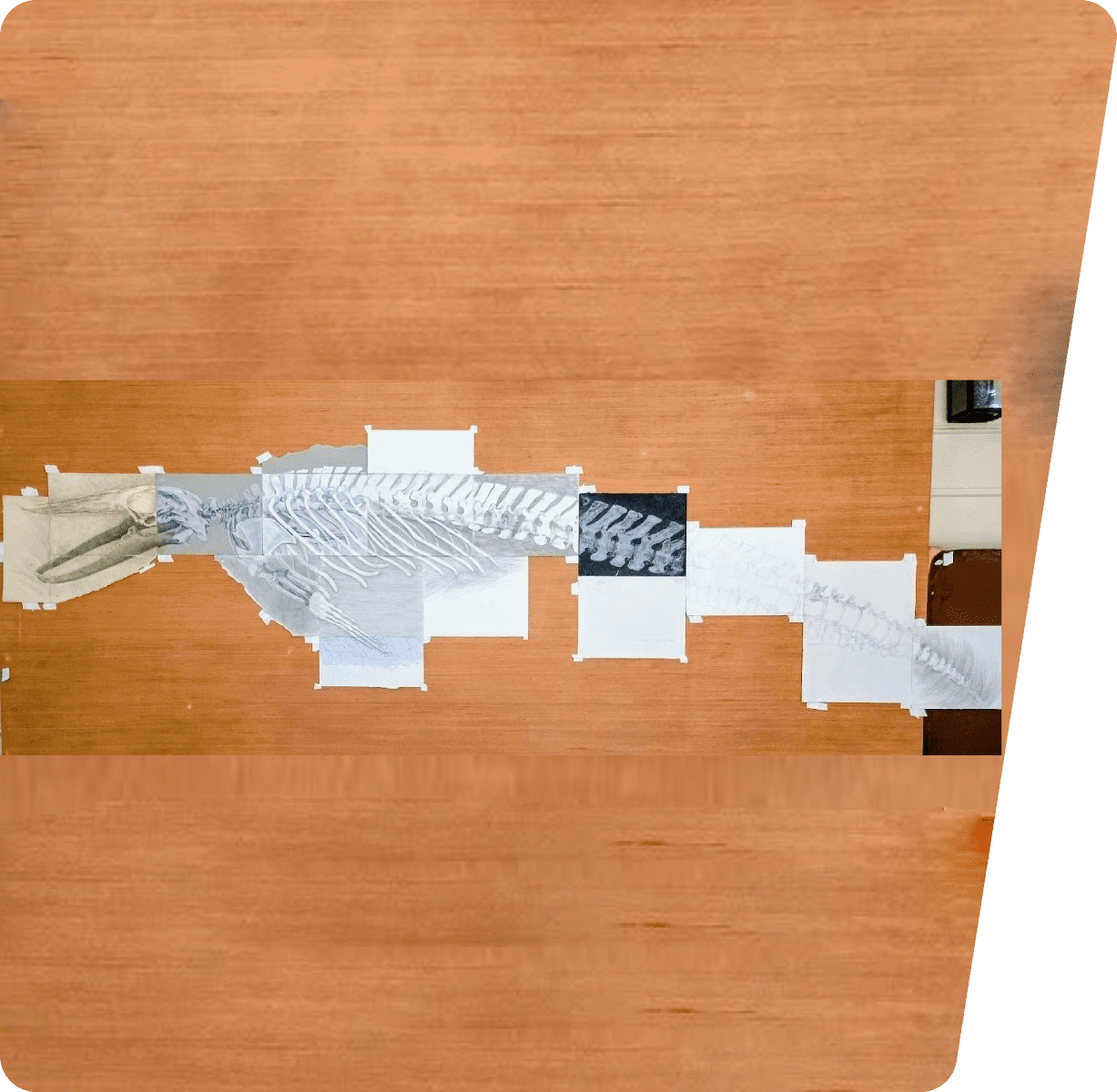
Blue Whale Composite Documentation
In August of 2022, I began a composite drawing of the blue whale skeleton that hangs in the North Carolina Museum of Natural Sciences. My limited attempt at understanding this creature began on an 8.5”x 11” sketchbook page, with a detailed observation of its skull. But I realized as I finished this initial drawing that this small drawing was completely inadequate in expressing my wonder at the size of this creature, the largest animal to ever inhabit Earth. I added on pieces of paper to extend its rostrum and jaw to create a more accurate representation of the full skull.
In the spring of 2025, as I completed the full length of the skeleton, I realized at some point that the vertebrae in my drawings were getting bigger as I approached the caudal area of the spine. I began to look for reasons why that might anatomically be accurate. Did the bones have to be larger for more thrust while swimming? I was steered toward some scientific articles that seemed to support this. But I also noticed that the skeleton was not hanging square in the space; the tail was closer to the railing than was the skull. Long story short (no pun intended), multiple factors were coming into play. The nearly nine-foot-long composite drawing was indeed too long.
A current exhibit on blue whales at the museum stated that a blue whale’s skull was about one quarter of its total length, while the skull in my drawing is only about one sixth. I also failed to use the same magnification factor for my reference photos, so the photos farther down the spine were likely done at a higher scale. Once I corrected that, and with the original skull drawing as a reference, I was able to complete a composite reference photo that is much closer to the proper scale.
The composite drawing has now been on hold since these discoveries. It remains to be seen if I will complete the drawing as begun, hit “reset” with the new reference photos, or bail on the project entirely after three years of focus. The drawing itself meets the criteria for the purposefulness of “art 4 good”; I want to draw attention to the plight of ocean ecology, the uniqueness of God’s creation, and, if possible, raise money to fight the climate crisis and to protect cetaceans by exhibiting this work, giving artist’s talks on it, and/or selling copies of the finished piece.
At his point my curiosity and passion took over, and I began a years-long pursuit of thoroughly examining the skeleton in adjoining drawings. The ultimate goal was to create a series of drawings which, when mounted end-to-end, would accurately represent the massive scale, and my draw-dropped wonder at it.
As I stood drawing at the railing of the balcony, I was sometimes asked if I was a scientist. Though my approach to this drawing has been more scientific than anything I had ever done before, I sometimes explained that the “science” of the project was the depiction of the bones, while the “art” of the project was in the variety of ways I depicted those bones and the space that I drew around and between them.
I’d like to claim a scientific approach to drawing the specimen, by creating an 8.5 x11” viewfinder to more accurately transfer what I was seeing before me to the page, as well as using photographs so I could work at home. But I ran into problems created by the “parallax effect” of peripheral vision; the drawings do not ideally line up end to end. A rib in at the right side of one drawing, for example, would still be visible in the next drawing, but at a totally different angle. Vertebrae would sometimes be drawn twice.